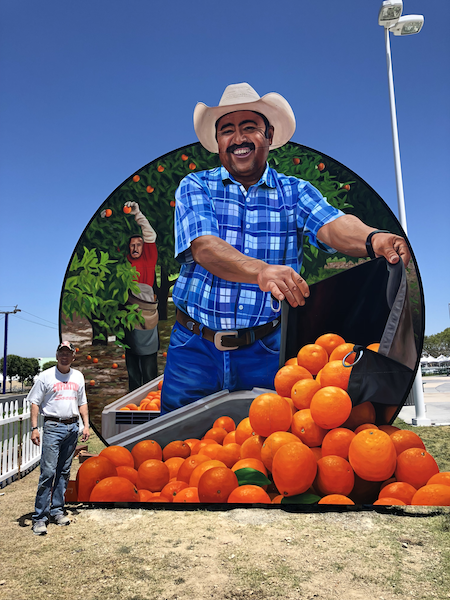
You're driving down Highway 68, maybe heading to Monterey from Salinas, mind somewhere else entirely — grocery list, the meeting you just left, what's for dinner. Then something registers at the edge of your vision and your brain slams the brakes.
There are people in that field. Giant people. Twenty feet tall, working in the rows, backs turned to the road, completely unbothered by the fact that they are enormous.
"When you're driving, your mind is in a trance," says Salinas artist John Cerney. "Then, suddenly, you see something strange. It's art. It shakes up your day for a few seconds."
That moment of double-take — that split second of genuine uncertainty about what you're seeing — is the whole point. And for nearly three decades, Cerney has been engineering it, one giant plywood figure at a time.
A Salinas Kid Who Ended Up in the Lettuce
John Cerney is a native son, born in Carmel and raised in Salinas. After graduating from Salinas High, he followed the path of many of his peers by entering the lettuce business. He worked in the coolers, drove a forklift — that kind of stuff. He had no art training and little interest.
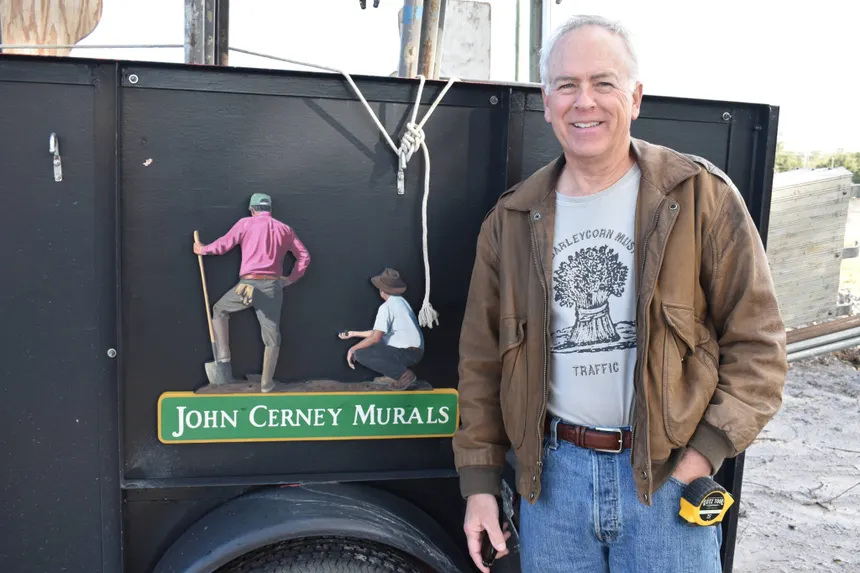
At 26, he decided his current path was a dead end. He enrolled at Cal State Long Beach and earned an art degree in 1984, then spent the next few years selling pencil portraits for celebrity clients including comedian John Candy and hockey legend Wayne Gretzky. It paid well. It wasn't enough.
Pencil drawings paid well, but Cerney longed for a larger audience. A mural of a mechanic shop painted on a century-old barn off Highway 68 during one of his visits back home became his first public art project. He tracked down the building's owner, got permission, and painted it. Drivers slowed down. People talked about it. Something clicked.
"I realized I didn't need buildings to paint on anymore," Cerney recalls. He learned how to build scaffolding from contractor friends and started creating the larger-than-life, photo-realistic portraits that now define the Monterey County landscape.
The Big Idea
The defining moment came in 1995. Chris Bunn, general manager at Crown Packing, wanted to do something to honor agricultural workers. "I was tired of people bad-mouthing agriculture," Bunn explained, "thinking everything comes out of a bag or carton. I was trying to show the community it takes a lot of people to grow food."
Cerney created a series of 10 large fieldworkers — 18 feet tall — for the local farmer who wanted to pay tribute to the agricultural labor force. Cerney found his blueprint and was soon branching out into group scenes, often telling a story with a Norman Rockwell-like sense of humor.
"The original two figures with their backs to the highway are the biggest step in my whole career," says Cerney. Before that, his outdoor work consisted of murals and life-size figures. Going giant changed everything.
A Gallery Without Walls
Cerney dubs his works "highway art" — and his studio has been a Salinas industrial warehouse since 1994, where he works from 9am to 10pm on most days. His favorite tool, famously, is a post-hole digger. His gallery is every road in Monterey County.
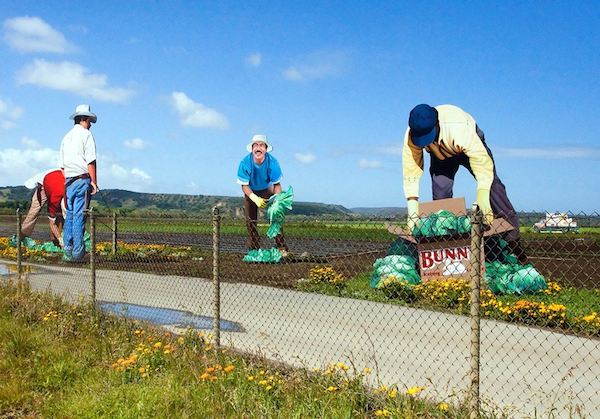
The installations you've probably seen without necessarily connecting them to one artist include the farmworker harvesting crews along Highway 68 near The Farm, the figures at Sam's Produce Stand, the dog welcoming visitors to the SPCA on Highway 68, the motorcycle and race car at Laguna Seca, a portrait of James Dean at Brookdale Lodge, a young girl on the Carmel Valley Art Association building, and the dramatic auto accident scene that has startled more than a few drivers over the years.
"At this point there are between 30 and 40 of my pieces around the county," he says. And his work now resides in 22 states — from Iowa cornfields to the Phoenix Zoo, from Central Valley highways to Big Sur International Marathon mile markers.
The Marathon Miles
That last one deserves mention. For years Cerney has created figures to mark the miles of the Big Sur International Marathon — a rogues' gallery of characters including a hooded figure holding a sign reading "The End Is Near" (retired after the Boston Marathon bombing) and a life-size replica of local news anchor Brittany Nielsen holding a microphone at one of the later miles. "This will make a few runners slow down to take selfies," Cerney joked when creating the Nielsen piece.
Art for Everyone
What makes Cerney's work unusual in the world of public art is that it requires no gallery admission, no artist statement, no prior knowledge of art history. It ambushes you on your commute.
Celine Pinet, dean of Fine Arts at Hartnell College, celebrates Cerney's work for its empowering qualities. "The size of his work is always interesting," Pinet says. "But what's even better is that the people of Salinas Valley can identify with it. It's public art for the populace."
Cerney himself has been clear about the motivation behind the agricultural figures in particular. "My first job was picking strawberries when I was 15 years old," he said. "I know how hard the work is. They get up early and it's a rough life. They're still underpaid. They work hard and I was happy to get that first gig and elevate them and draw attention to them."
Go Find Them
Next time you're on Highway 68 heading west out of Salinas, or driving Highway 101 through the valley, or turning onto Hitchcock Road — look up. The giants are out there. They've been there for decades, working the fields and parking lots and roadsides of Monterey County, waiting for someone to notice them between destinations.
John Cerney has been making sure you do

Comments (0)
Leave a Comment